Your Medication

Page last reviewed: 01 July 2026
Page created: 30 June 2026
Page created: 30 June 2026
We've put some small files called cookies on your device to make our site work.
We would also like to use google translate cookies and analytical cookies to understand how our site is used and improve user experience. Analytical cookies send information to Google Analytics.
Let us know your preference. We will use a cookie to save your choice. Before you make your choice you can read more about our cookie policy.
You can change your cookie settings at any time using our cookie policy.
Why your GP prescribes medicines by their drug (generic) name
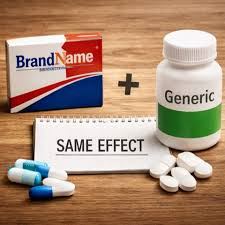
When you receive a prescription from our practice, you may notice that your medicine is prescribed using its generic (chemical) name rather than a brand name.
Many patients wonder why this is, especially if they have previously received a medicine with a familiar brand name or if the packaging looks different.
We hope this page explains why we prescribe this way and reassures you that your medicine has been chosen because it is safe, effective and represents good value for the NHS.
A medicine contains an active ingredient (the chemical that treats your condition).
For example:
|
Brand name |
Generic (drug) name |
|
Panadol |
Paracetamol |
|
Nurofen |
Ibuprofen |
|
Lipitor |
Atorvastatin |
A branded medicine is developed and marketed by a pharmaceutical company, usually while it is protected by a patent.
Once that patent expires, other manufacturers can produce the same medicine. These are known as generic medicines.
Although the packaging, tablet shape, colour or manufacturer may differ, the medicine contains the same active ingredient in the same strength and must meet the same strict quality, safety and manufacturing standards.
Yes.
Before a generic medicine can be licensed for use in the UK, it must demonstrate that it is equivalent to the branded medicine.
This means it must:
The Medicines and Healthcare products Regulatory Agency (MHRA) carefully regulates all licensed medicines supplied in the UK.
Prescribing by the generic (chemical) name is standard NHS practice because it:
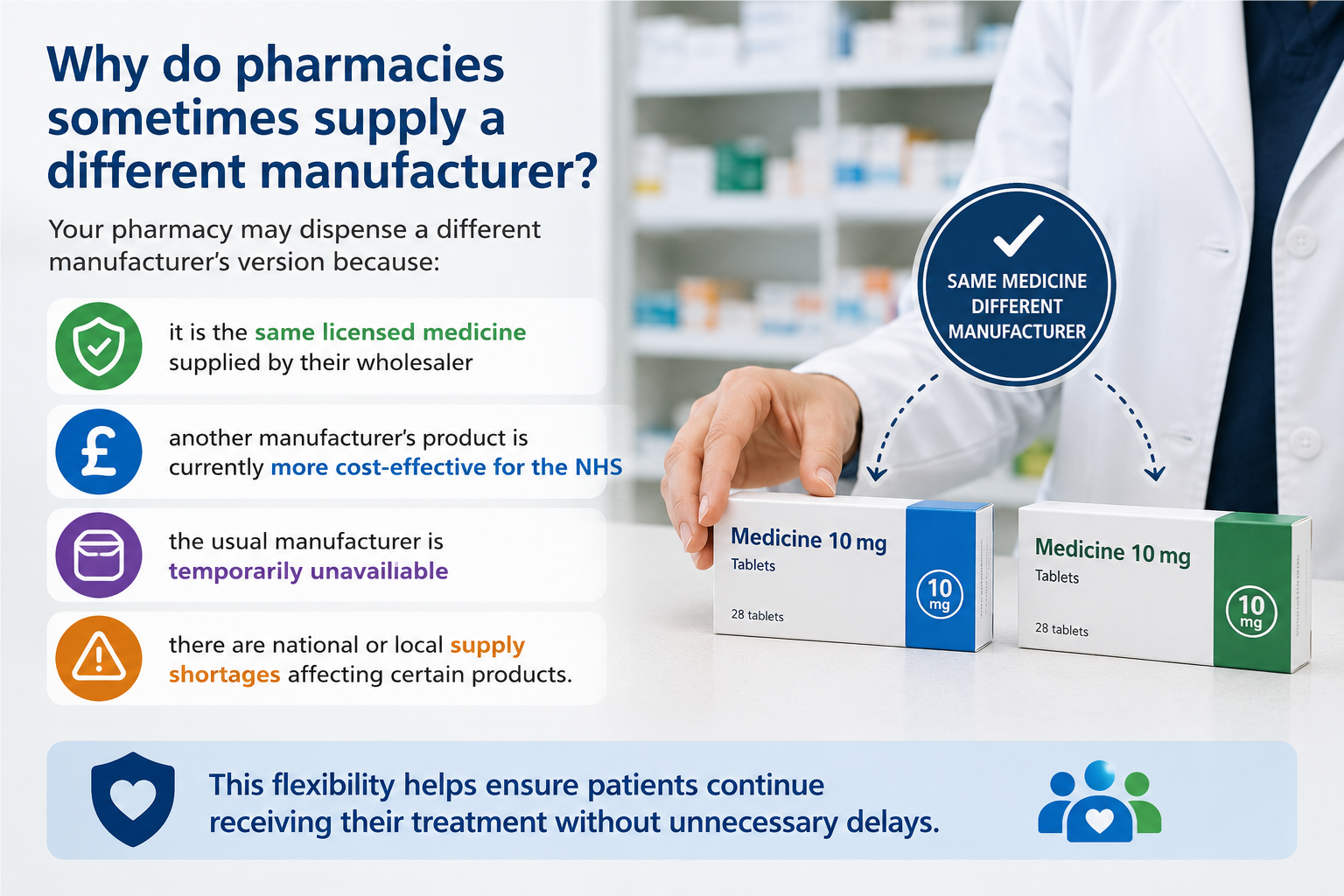
It also gives pharmacies flexibility to supply whichever approved version is currently available.
From time to time you may notice that:
This does not necessarily mean your medicine has changed.
Often, it is exactly the same medicine made by a different manufacturer.
The active ingredient and dose remain the same.
Most patients notice no difference when changing between manufacturers.
However, we recognise that some patients feel their medicine seems different after changing to another manufacturer.
There can be several reasons for this, including:
If you feel your medicine is not working as expected, please do not stop taking it without seeking advice.
Instead:
We will always take your concerns seriously and review your medication if needed.
Yes.
Although generic prescribing is appropriate for most medicines, there are some medicines where a specific brand is recommended because small differences between manufacturers can affect how the medicine works or because patients require a consistent product.
Where national guidance recommends prescribing a particular brand, your GP will prescribe that brand.
Our practice follows NHS prescribing guidance by prescribing medicines using their generic (chemical) name whenever it is clinically appropriate.
This approach:
If you have any concerns about your medication or notice unexpected changes after receiving a different manufacturer's product, please speak to your pharmacist or contact the practice. We are always happy to discuss your treatment and ensure you receive the medication that is most appropriate for your individual needs.